












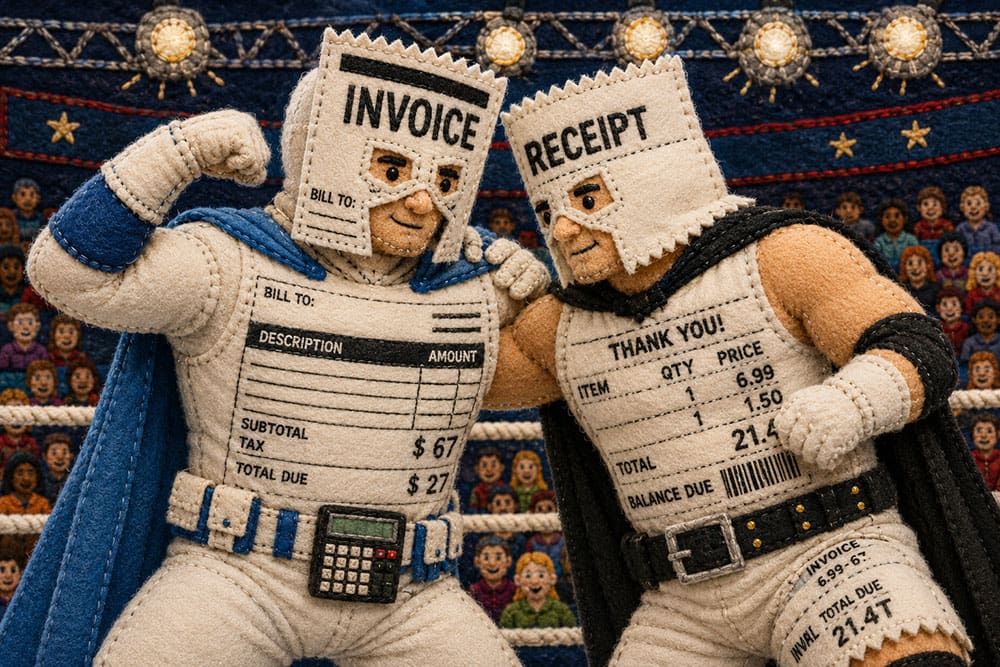
People often treat invoices and receipts as the same thing. They are not. Getting clear on invoice vs receipt differences for invoicing and payments changes a lot of day-to-day decisions: when you bill a client, how you record a sale, and what you hand to an auditor. This isn’t philosophy. It’s paperwork and cash flow.
Key Takeaways
- An invoice is a request for payment that establishes a claim, while a receipt is proof that payment was made and extinguishes it.
- Every invoice needs seller and buyer details, a unique invoice number, date, description, quantity, price, taxes, total due, and payment terms.
- Under accrual accounting, invoices recognize revenue when the sale occurs, while receipts record cash-basis transactions when money actually arrives.
- Treating an unpaid invoice like cash leads to overspending, and losing receipts forces you to reconstruct payments from bank statements at tax time.
- When a payment arrives, mark the invoice paid, email a receipt, and keep both records linked in your accounting system.
What An Invoice Actually Does
An invoice is a request for payment. It lists goods or services provided, the amount due, payment terms, and usually who will pay. An invoice can be dated today and due in 30 days. It doesn’t mean you’ve been paid; it means you asked to be paid. Start with the invoicing basics: invoicing is about timing, obligation, and tracking expected income.
Required Elements On An Invoice
What you need on an invoice is straightforward: seller details, buyer details, invoice number, date, description of products or services, quantity, price, taxes, total amount due, and payment terms. That invoice number matters because it’s how your accounting ties a charge to a record.
Why Invoices Matter For Cash Flow
If you’re running a small business, invoices are how you predict cash. A stack of unpaid invoices signals that revenue exists on paper but not in the bank. The difference between invoicing and payments will determine whether you need a short-term loan, wait on larger purchases, or fire up a collection process.
What A Receipt Actually Is
A receipt is proof of payment. It says money changed hands, or a payment cleared. A receipt doesn’t request anything; it confirms fulfillment. If a client paid by credit card, the receipt shows the amount paid, method, and date. Keep receipts for tax deductions, returns, and customer service disputes.
Typical Receipt Details
Receipts usually include date, items purchased, total paid, method of payment, and sometimes a transaction ID. They can be simple: a cashier’s printed slip or a digital PDF sent after an online payment. That simplicity is its strength. A receipt proves a transaction closed.
Timing And Legal Implications
The clearest invoice vs receipt differences for invoicing and payments show up in timing and legal effects. An invoice establishes a claim; a receipt extinguishes it. For example, if you send an invoice and the client never pays, you still have the right to pursue it. If you hand over a receipt, you can’t reasonably ask for that payment again.
Tax And Accounting Differences
From an accounting perspective, invoices recognize revenue on an accrual basis when the sale occurs, even if cash hasn’t arrived. Receipts are used to record cash-basis transactions. If you’re doing invoicing basics right and using accrual accounting, your income statement will show revenue when invoices are issued. Cash-basis accounts will wait for receipts.
Contractual And Warranty Issues
Selling a laptop under warranty: the invoice might be useful for warranty registration because it shows what was sold and when. The receipt proves the customer paid and may be necessary for returns. For legal disputes, courts and regulators often want both: an invoice to show the original obligation and a receipt to prove settlement.
Common Confusion: Receipts Vs Invoices In Everyday Use
Many service providers hand a document that looks like an invoice at the time of sale and call it a receipt. That’s honest shorthand, but it complicates record-keeping. When comparing receipts vs invoices, think about the function you need. Are you documenting a request for payment or proof that payment occurred?
Retail Example
In a shop, the clerk typically prints a receipt at checkout. There’s no invoice because the sale is immediate. In B2B sales, however, the vendor often sends an invoice and waits for payment. Someone who tries to file a refund using an invoice instead of a receipt will find store policies can be strict about proof of payment.
Professional Services Example
A consultant might submit an invoice after finishing work, with 30-day terms. When the client pays, the consultant sends a receipt. If the consultant only maintains invoices and not receipts, clients may request additional proof when reconciling expenses. That wastes time.
How To Use Both Without Messing Up Books
Standardize what you call things. Label documents clearly. If your accounting software lets you convert an invoice to a receipt automatically when payment is recorded, use that feature. That avoids having separate templates that look confusingly similar.
Practical Steps For Small Businesses
Make a habit of issuing invoices with clear due dates and unique numbers. When a payment arrives, mark the invoice as paid and email a receipt. Keep both records linked in your accounting system. These are invoicing basics, and they prevent disputes and speed up audits.
Mistakes I See All The Time
One big mistake: treating an unpaid invoice like cash. That leads to overspending. Another is losing receipts and trying to reconstruct payments from bank statements alone. Both cause headaches during tax season. A third common error is failing to distinguish between deposits and final payments. A deposit is often accompanied by an invoice but only turns into a receipt once the deposit is accepted and recorded.
Audit Red Flags
Auditors want serial control on invoices and receipts. Missing invoice numbers, duplicate receipts, or manual alterations flag scrutiny. If you can’t show that invoice #1023 was paid because a receipt is missing, expect follow-up. Keep originals or digital copies with timestamps.
Tools That Make The Difference
Modern accounting tools will highlight invoice vs receipt differences for invoicing and payments automatically. They let you issue an invoice, accept payment online, and then generate a receipt without extra work. They also reconcile bank statements, matching payments to invoices so you don’t hunt for stray transactions.
Choosing Software
When picking software, look for clear workflows: issue invoice → record payment → generate receipt → reconcile. If the system forces you to manually create separate documents each time, you’ll forget or mislabel things. Look for features like automated reminders for unpaid invoices and digital receipts that attach to the original invoice.
Real-World Scenarios That Clarify The Difference
Scenario A: You sell $5,000 of equipment and invoice the buyer. They pay in 45 days. The invoice shows the obligation; the later receipt proves payment. Scenario B: You run a café. A customer pays cash. The receipt is printed and the sale is recorded, and no invoice was necessary. Scenario C: A client sends a purchase order, you issue an invoice, they overpay. The overpayment becomes a credit note or you issue a receipt and refund. These examples illustrate how receipts vs invoices play different roles depending on the business flow.
Tips For Clean Records
- Keep invoice numbers sequential and never reuse them.
- Email receipts promptly after payment with a clear reference to the invoice number you’re settling.
- Use the same terminology with clients, and don’t call a due invoice a receipt.
- If you accept partial payments, record each partial payment with its own receipt and link them to the original invoice.
When Disputes Happen
If a client disputes a charge, the invoice shows what you billed and on what terms; the receipt shows whether they actually paid. Both are important in dispute resolution. If a vendor claims non-payment but you have a receipt, push back with that evidence. If you have only an invoice and no receipt, be prepared to prove payment by bank transfer record or credit-card batch ID.
Training Staff On These Differences
Teach front-line staff the distinction early. Cashiers need to understand receipts; salespeople need to know invoices. Simple role-play helps: one person mails an invoice and follows up; another records a received payment and issues a receipt. That hands-on practice fixes a lot of procedural drift.
What To Keep For Taxes
Tax authorities typically want receipts to prove expenses and invoices to support income claims. For VAT/GST, invoices often serve as the legal document for claiming credits, while receipts show the tax was actually paid. Keep both for the statutory retention period required in your jurisdiction.
Automate But Verify
Automation reduces errors, but it can hide nuance. A system that automatically marks an invoice paid when a payment is initiated but not yet cleared can create problems. Periodically verify that payments matched to invoices were actually settled and that receipts are correctly timestamped and stored.
Software that highlights invoice vs receipt differences for invoicing and payments will save time. But a little human review prevents misapplied payments and keeps your books clean.