















If you want to know whether your business will survive the next slow quarter, start with margins. Margin calculation for small business profitability and cash flow isn’t an academic exercise; it’s the tool that tells you which products actually pay the rent and which ones quietly drain cash. Do it wrong, and the numbers look fine while your bank balance dwindles. Do it right, and you can spot trouble early and take concrete steps.
Key Takeaways
- Gross margin shows what is left after direct costs, operating margin after overhead, and net margin after interest and taxes, and each step reveals where money leaks.
- A print shop with $20,000 in sales and $8,000 in direct costs has a 60% gross margin, dropping to 25% operating and 17.5% net.
- Run the three formulas on your last three months of actuals and compare month to month, since a swinging gross margin usually signals input-cost or pricing problems.
- Price from a margin target instead of guessing, so a $10 wholesale cost at a 60% target gross margin becomes a $25 retail price.
- Seasonal businesses should treat strong summer margins as cash to save, because a 25% summer operating margin can turn to negative 5% in winter.
How Margins Actually Work In Real Shops
Gross margin answers a simple question: after covering direct costs, how much of each dollar of sales is left? Operating margin asks what remains after you add overhead. Net margin gives you the bottom-line after interest and taxes. People confuse these because they sound close. They aren’t.
Margin decisions show up in the monthly numbers, so pair this work with the free budget and cash flow templates and watch the break even point move as pricing changes.
A quick example makes it concrete. Suppose you run a small print shop:
– Monthly sales: $20,000.
– Direct costs (paper, ink, labor on jobs): $8,000.
Gross profit = $12,000. Gross margin = 12,000 / 20,000 = 60%.
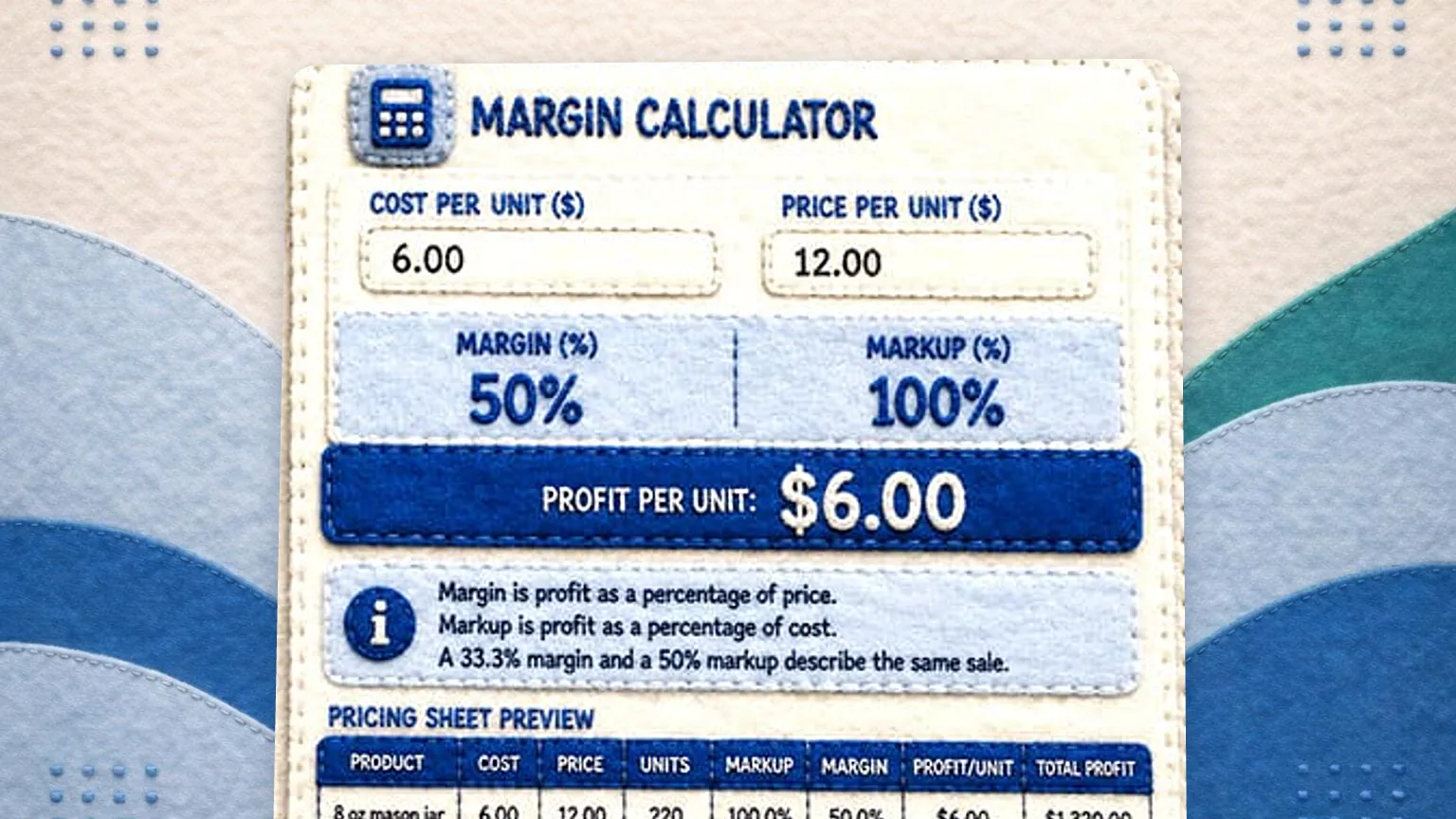
The arithmetic behind all of this is worth doing once by hand and then handing to a tool. The free margin calculator works out gross margin from cost and price, and it also builds a blended margin across several products, which is the figure that actually describes a mixed catalogue.
Then add rent, utilities, marketing and admin of $7,000. Operating profit = $5,000. Operating margin = 25%. After interest and taxes, net might be $3,500, net margin 17.5%.
That chain from gross to net is the main story behind your margins. Each step tells you where money is leaking.
How To Calculate Gross, Operating, And Net Margins

Gross Margin = (Revenue − Cost Of Goods Sold) / Revenue
Operating Margin = Operating Income / Revenue
Net Margin = Net Income / Revenue
You don’t need fancy software to calculate these. Use your last three months of actuals and run the three formulas. Compare month-to-month. Swinging gross margin usually signals input-cost changes or pricing problems. A steady gross margin but falling operating margin? Look at overhead.
Margins are also a way of converting messy bookkeeping into small, actionable metrics. If your gross margin falls from 60% to 50% because a supplier raised prices, the fix may be switching suppliers, raising prices, or cutting a direct cost. If operating margin slides, renegotiate leases, review subscriptions, or rethink staffing.
Example: A Coffee Shop
A small café sells $30,000 a month:
– Beans and direct materials: $6,000.
– Barista wages tied to sales: $4,500.
COGS = $10,500. Gross profit = $19,500. Gross margin = 65%.
Fixed costs (rent, utilities, insurance) = $9,000. Variable marketing and admin = $1,500. Operating income = $9,000. Operating margin = 30%. If you reduce food waste and save $700 on COGS, gross margin rises to nearly 67.3% and operating income improves without increasing sales.
Those points illustrate why margin work is not only about pricing. It’s about processes that affect costs directly.

Using Margins To Set Prices Without Killing Demand
Most small business owners feel torn between raising prices and keeping customers. Use margin targets instead of guessing. Pick a target gross margin for each product or service that covers direct costs and contributes to fixed costs. If your allocation method shows an item can never meet that margin at current price and volume, it’s either mis-priced or it shouldn’t be sold.
A retailer can set a target margin: if wholesale cost is $10 and desired gross margin is 60%, retail price = 10 / (1 − 0.60) = $25. Simple math avoids emotional pricing and prevents items that look popular from dragging down financial health.
Make pricing rules: for example, never sell below a margin that covers allocated overhead plus a small buffer for cash flow. That buffer is where margin math really matters, because you’re protecting the cash needed to keep payroll and suppliers happy.
Quick Checks To Spot Margin Problems
– Compare gross margin by product category. Averages hide losses.
– Track days sales outstanding and inventory turnover; margins mean little if cash is tied up.
– Reconcile your cost of goods: missing supplier invoices or misclassified payroll quietly inflate COGS.
– Watch promotions. Frequent discounts can erode margins faster than they boost volume.
– Monitor customer returns and service costs; after-sale costs reduce actual margins.
These checks are a quick health test. They’re fast, and they often point straight to the fix.
Scenario: Seasonal Business And Cash Flow
Imagine a small landscaping company with high gross margins in summer but nearly zero work in winter. Average annual margin might look fine, but cash flow dries up in December. Use margin calculation for small business profitability and cash flow to create a seasonal cash plan: build a reserve equal to a few months of fixed costs when margins are strong. That way you don’t need costly short-term financing, and you can avoid layoffs that hurt future revenue. Pricing decisions get easier alongside the rest of running a small business.
You’ll see this play out in the numbers. If your summer months produce an operating margin of 25% and winter months −5%, you must treat the 25% as partly cash you need to save, not all spend.
How Margins Feed Into Your Planning

Profitability analysis isn’t a one-off. It’s a weekly or monthly routine that combines margin tracking with sales forecasts and cash timing. Start with a simple rolling forecast: three months of actuals and nine months of projections. Feed in margin assumptions by product, and update as costs change.
When you model scenarios, such as a 10% supplier hike or a marketing push that increases sales 15% but adds fixed cost, margins show whether the push improves financial health or just inflates revenue without profit. Looking at margins this way helps you choose actions that move the needle on cash, not just sales.
Make one change at a time in forecasts so you can see the marginal impact on net cash. That clarity prevents simultaneous moves that make evaluations impossible.
Practical Ways To Improve Margins Quickly
– Negotiate with suppliers for volume discounts or longer payment terms. Small percentage drops in COGS compound quickly.
– Reduce product complexity. SKUs that sell little but consume overhead often have negative margins once returns and promotions are counted.
– Automate low-value administrative tasks to cut operating costs without cutting customer-facing roles.
– Increase upsells on higher-margin items. Moving a customer from a basic service to a premium add-on can improve both gross and operating margins.
– Reprice legacy contracts that haven’t kept pace with cost inflation. Set a policy to review all contracts annually.
Each tactic affects margins and cash flow differently. Track the impact in monthly statements and adjust.
When Margins Look Fine But Cash Feels Tight
Margins can be misleading if timing is off. You might have strong net margins on paper because you recognized revenue, but customers pay late. Conversely, you might buy inventory early to secure discounts, which shows on cash flow but not immediately on profit.
That’s why margin analysis should always be paired with cash forecasting. A business with thin margins and fast receivables is riskier than one with thicker margins and stable cash conversion.
Check your cash conversion cycle: Days Inventory Outstanding + Days Sales Outstanding − Days Payable Outstanding. Shrink that cycle and your cash position improves even if margins stay constant. This is one of the less-discussed levers for financial health.
Tools That Make Margin Work Easier
You don’t need enterprise software. A clean accounting package, a spreadsheet, and a handful of standard reports will do the job. Set up:
– A product-level profit and loss report to see gross margins by SKU.
– A monthly operating P&L with trend lines for major expense categories.
– A rolling cash forecast tied to margin assumptions and payment terms.
Outsource the bookkeeping if it’s inconsistent. Bad data ruins margin analysis faster than any other issue. You might receive a small improvement in clarity just from cleaner reports.
When To Get External Help
If margins are eroding and you can’t find the cause, bring in a fractional CFO or a consultant who can run a profitability analysis and stress-test scenarios. They’ll ask hard questions about customer lifetime value, hidden cost allocations, and pricing discipline. Expect to pay, but the right guidance often pays for itself quickly by identifying the few levers that restore financial health.
Don’t wait until the bank calls. Use margin calculations as an early-warning system. If you track these metrics monthly, you can fix problems while they’re still manageable.